
Florida Licenses Pool Work as Three Trades. Your Website Says One.
A Naples homeowner planning a pool spends months on questions that have nothing to do with choosing a builder. What does the county require. How high does the fence have to be. Can the screen enclosure count. What happens at final inspection. Those searches are where the relationship starts, and almost no pool company in Collier County answers them. They publish a gallery and a contact form, then compete for the one search that happens last.

Pool builder SEO is the practice of ranking for the permitting, code, design and cost questions homeowners research before they select a contractor, structured around the separate scopes of work Florida actually licenses, rather than collapsing construction and servicing into a single page.
Florida Licenses Your Work as Three Separate Trades
Florida issues distinct pool credentials with distinct scopes. A Residential Pool/Spa Contractor covers construction, repair and servicing of residential pools. A Commercial Pool/Spa Contractor covers the same for any pool. A Swimming Pool/Spa Servicing Contractor covers servicing and repair only, and cannot build (Florida DBPR, 2026). Three licensed scopes are three buyers, and they belong on three pages.
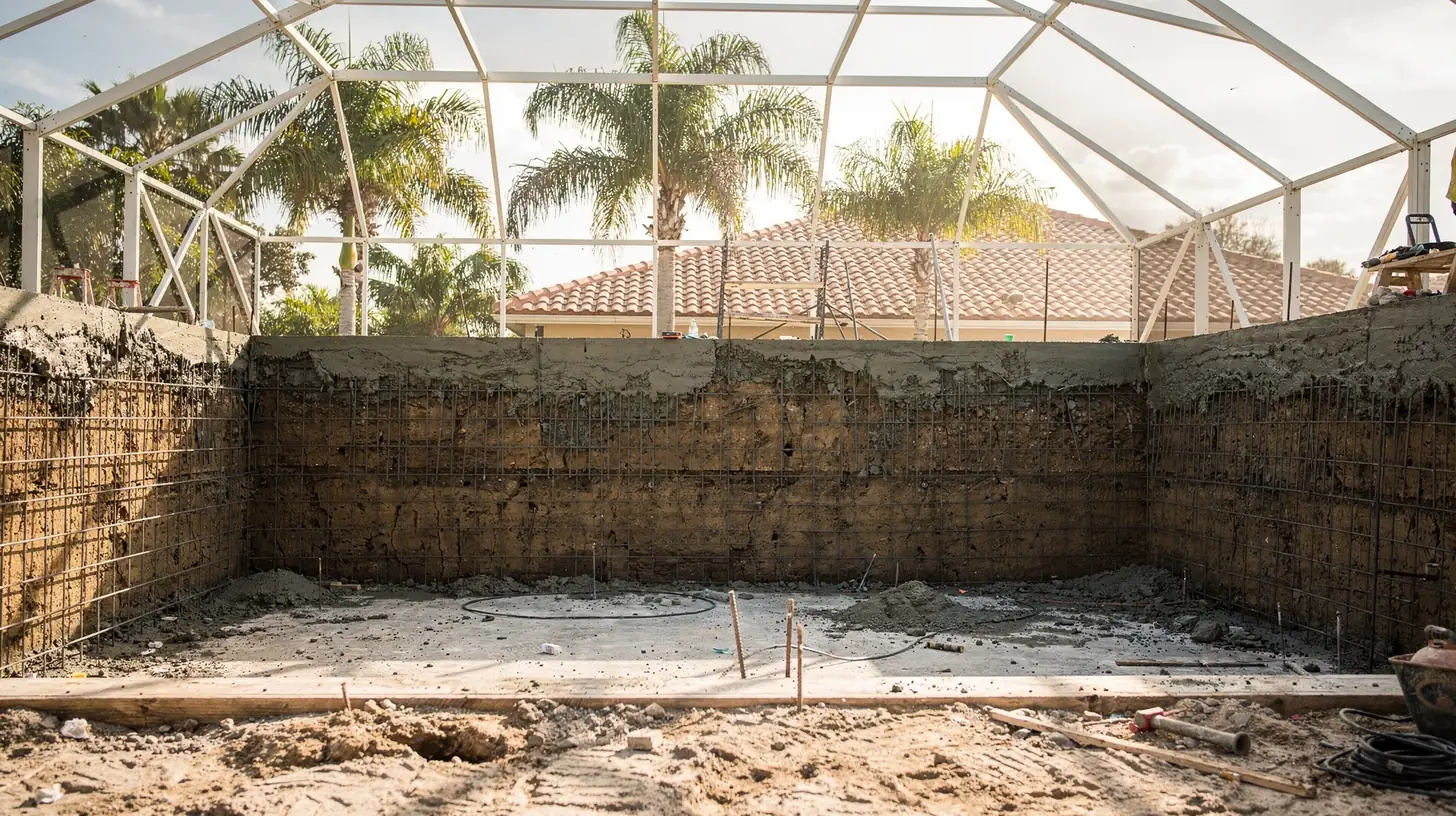
Start with the state, because the state has already done the hard part of the architecture for you.
Florida’s Construction Industry Licensing Board issues separate pool credentials with separate scopes of work. A residential pool contractor is licensed for the construction, repair and servicing of any residential swimming pool, hot tub or spa, covering the layout, excavation, steelwork, installation of light niches, construction of floors, guniting, fiberglassing, installation of tile and coping, perimeter and filter piping, plastering of the interior and construction of decks (Florida DBPR, 2026). The commercial category covers the same work without the residential limit. The servicing category is narrower: servicing and repair, replastering, reconstruction of decks, replacement of piping, filter equipment and chemical feeders (Florida DBPR, 2026).
Note what that means commercially. Someone who wants a pool built and someone who wants a pool resurfaced are not the same buyer, are not at the same stage, are not worth the same money, and in Florida are not even served under the same license category. Yet the typical Southwest Florida pool website has one page called Pool Services that gestures at all of it.
That page cannot rank well for any of those searches, and the reason is not mysterious. It answers no single question completely. A homeowner researching a new build finds resurfacing copy; a homeowner with a failing heater finds construction galleries. Both leave. The engine, meanwhile, has no clear signal about what the page is for, so it ranks it weakly for everything rather than strongly for anything.
The fix is to let the license structure be the site structure. If you hold the residential construction credential, the build page is your money page and it should read as though servicing does not exist. If you also service, that is a separate page for a separate person.
The Searches That Happen Months Before Anyone Calls a Builder
The decision to hire a pool builder is the end of a long research process, not the start. The questions asked during it are about permits, barriers, enclosures, lot constraints and cost ranges. Those searches have real volume, weak answers, and are asked by exactly the homeowner who is about to spend six figures.
Think about the actual sequence in a Naples household. Somebody decides they might want a pool. Then come months of questions, and none of them is the name of a company.
What does Collier County require to permit a pool. How high does the barrier have to be. Does an existing screened lanai satisfy the requirement or is a separate fence needed. What is the difference between a gunite pool and a fiberglass one in our soil. How close to the seawall can it go on a canal lot. What does a pool actually cost here, honestly, including the deck and the cage. How long does the whole thing take.
Every one of those is a search. Every one is asked by a homeowner with intent and a budget. And in most local markets the results are a mix of national content farms that know nothing about Collier County and thin pages that answer half the question before demanding a phone number.
That is the opening. A builder who answers those questions properly, with local specifics, becomes the source the homeowner has been reading for two months before they ever fill in a form. By the time they make contact they are not comparing three quotes from strangers. They are calling the company that taught them how this works.
It is also the content that AI answer engines can actually use. A question with a clear, specific, sourced answer is the shape those systems quote. A gallery page is not.
The Safety Rules Are a Content Asset, Not a Disclaimer
Florida requires a residential pool to meet at least one listed safety feature to pass final inspection and receive a certificate of completion (Florida Statutes section 515.27, 2025), and sets barrier rules including a minimum height of 4 feet on the outside (Florida Statutes section 515.29, 2025). Most builders bury this. It answers a question homeowners genuinely search.
Here is a concrete example of a page nearly nobody publishes well, built entirely from public law.
Florida requires that to pass final inspection and receive a certificate of completion, a residential swimming pool must meet at least one of a listed set of safety features (Florida Statutes section 515.27, 2025). The options include isolating the pool from the home with a qualifying enclosure, an approved safety pool cover, exit alarms on the doors and windows giving direct access, self-closing and self-latching devices on those doors, and a pool alarm meeting the referenced ASTM standard (Florida Statutes section 515.27, 2025).
The barrier rules are equally specific. The barrier must be at least 4 feet high on the outside, and may not have gaps, openings, indentations, protrusions or structural components that could let a young child crawl under, squeeze through or climb over it (Florida Statutes section 515.29, 2025). Gates must open outward away from the pool, be self-closing, and carry a self-latching device with the release on the pool side, placed so a young child cannot reach it (Florida Statutes section 515.29, 2025). The barrier must also sit far enough from the water that a child who does get past it does not fall straight in (Florida Statutes section 515.29, 2025).
Now consider how a homeowner meets that information today. They find a forum thread, a national blog with the wrong state, or a builder page that says permits and safety requirements apply, please contact us. A page that lays out the options plainly, says which ones are common on Naples lots and why, and explains what it means for their particular setup, is more useful than every gallery on the site put together.
Say clearly what such a page is and is not. It is an explanation of published requirements, not legal or code advice, requirements change, local amendments exist, and Collier County is the permitting authority for unincorporated Collier and the statute is the authority on the law. Writing that plainly costs nothing and makes the page more credible, not less.
Why One Pool Page Ranks for Nothing
A single page targeting new construction, renovation, resurfacing and service competes with itself and satisfies nobody. Split by the job the reader wants done, give each page its own question set, and link them deliberately so the site reads as a specialist rather than a generalist.
The mechanism here is worth being precise about, because the usual advice is just publish more pages, which is how sites end up with dozens of near-identical ones.
When several pages target the same intent, they divide the site’s own signals and none of them accumulates enough to win. When one page targets several intents, it satisfies none of them fully and loses to pages that do. Pool companies usually have the second problem, and solving it by adding thin variants creates the first.
Split by the job, not by the keyword. New construction is one job. Renovation and remodel of an existing pool is a genuinely different one, with different objections, a different budget and a different timeline. Resurfacing is different again. Equipment and heater work is different again. Screen enclosure and deck work often sits with a different trade entirely.
Then give each page a real question set rather than a paragraph of copy. The build page carries the permitting, timeline, materials and cost-range questions. The renovation page carries the how do I know it needs it, what does it cost against replacing, and how long will I lose the pool questions. Each is complete on its own terms, and each earns its ranking honestly because it is the best answer to a specific thing.
Then link them the way a specialist would. A homeowner reading about resurfacing may discover their pool is old enough that a rebuild makes more sense, and that path should exist on the page.
The Naples Detail That Cannot Be Templated
Local specificity is the one thing a national competitor cannot copy and a template cannot generate. Canal and seawall lots, screen enclosures against the bug and debris load, gated community architectural approval, and the difference between building in Collier and Lee County are all real constraints that change the job.
This is where a Naples builder has an advantage that no amount of national content spend can take away, and most give it away for free by writing as though the pool were in Ohio.
The constraints here are specific. A direct access canal lot in Aqualane Shores has setback and seawall considerations a dry lot in Golden Gate Estates does not. Screen enclosures are close to standard across Collier County for reasons any local can explain in one paragraph and a national writer will never think to mention. Gated communities from Pelican Bay to the Vineyards frequently run their own architectural review, which sits on top of county permitting and changes the timeline in a way that surprises buyers relocating from out of state.
And the county line matters. A builder working both Collier and Lee is dealing with two permitting authorities, and a homeowner in Bonita Springs or Estero is often genuinely unsure which one governs their address. A page that answers that clearly is useful in a way that no template output ever is.
Write the things you know because you work here. Which months the build calendar is tight. What the rainy season does to an excavation schedule. What relocating buyers consistently get wrong about lanai sizing. That knowledge is why a local builder deserves the job, and it is also, not coincidentally, the exact material that makes a page impossible to replicate.
It is worth saying plainly that this is slower than buying leads and it compounds instead of stopping. A shared lead costs the same every month and arrives in three other inboxes at the same time. A page answering the enclosure question keeps answering it.
What to Publish, in Order
Build the page for the license and job you most want to sell first, then the permitting and safety explainer, then renovation, then the local-constraint pages. Reviews and a complete Google Business Profile carry the map results in parallel, and neither is a content problem.
Order matters, because most companies do this in the sequence that is easiest rather than the sequence that pays.
First, the page for the work you most want. For most Naples builders that is new residential construction, and that page should be genuinely thorough: process, timeline, what is and is not included, materials, an honest cost range, and the permitting picture. An honest range published openly is a strong filter, and it removes the buyers who were never going to proceed.
Second, the permitting and safety explainer described above. It is the highest-intent informational page available to you and it is built from public law, so it costs research time rather than invention.
Third, renovation and resurfacing as their own pages, because that is a real second business with a shorter sales cycle that funds the wait for the construction pages to mature.
Fourth, the local-constraint pages: canal and waterfront lots, screen enclosures, gated community approvals, and the Collier versus Lee question. These are small pages with narrow audiences and very little competition.
Alongside all of it, treat the map results as a separate track. Category selection, service areas, photos of real completed work and a steady flow of reviews decide the map pack, and no amount of writing substitutes for them. Both tracks matter, they move at different speeds, and the map track usually moves first.
If you would like to see which of these questions your site already answers and where you stand against the other builders in your market, our free audit measures it and costs nothing, and the ongoing work is set out on our SEO for pool companies page.
Turn on what makes AI recommend you.
AI recommends the businesses it can read, trust and quote. Flip on the four signals we engineer, and watch your visibility climb and the answer rewrite itself.
Illustrative · the four signals are the real system we build
This article, answered.
The questions readers ask about this topic, answered the way an answer engine would. No forms, no sales pitch.
Pick a question on the left and you’ll get the direct answer, the way an answer engine would give it.
PUBLISHED August 31, 2026 · WRITTEN BY JAMIE KLONCZ, FOUNDER · SEO ELITE AGENCY, NAPLES FL
Enter a path and click verify.