
Everything Waterfront Owners Believe About Mangroves Is Half Right
Ask two neighbors on the same Collier County canal what they are allowed to do with the mangroves in front of their seawall and you will get two confident, opposite answers. One will tell you it is illegal to touch them. The other will tell you it is their property and their view. Both are wrong, and Florida settles it with numbers: heights in feet, a percentage of the shoreline, a staged limit on foliage, and a defined category of person allowed to do the bigger work. Those numbers are public and they are almost never on a contractor website.

Mangrove trimming in Florida runs on three tiers: work that is exempt from permitting when it stays inside published limits, work that fits a general permit, and work that needs a permit. Which tier a job falls into is decided by measurable facts about the trees and the shoreline, not by opinion.
Three Tiers, and Almost Nobody Explains the Middle One
Florida requires a permit to trim or alter mangroves unless the work meets published exemption criteria, and a delegated local government may impose stricter substantive standards but may not prohibit all mangrove trimming (Florida Statutes section 403.9328, 2025). Between exempt work and a full permit sits a general permit most owners have never heard of.
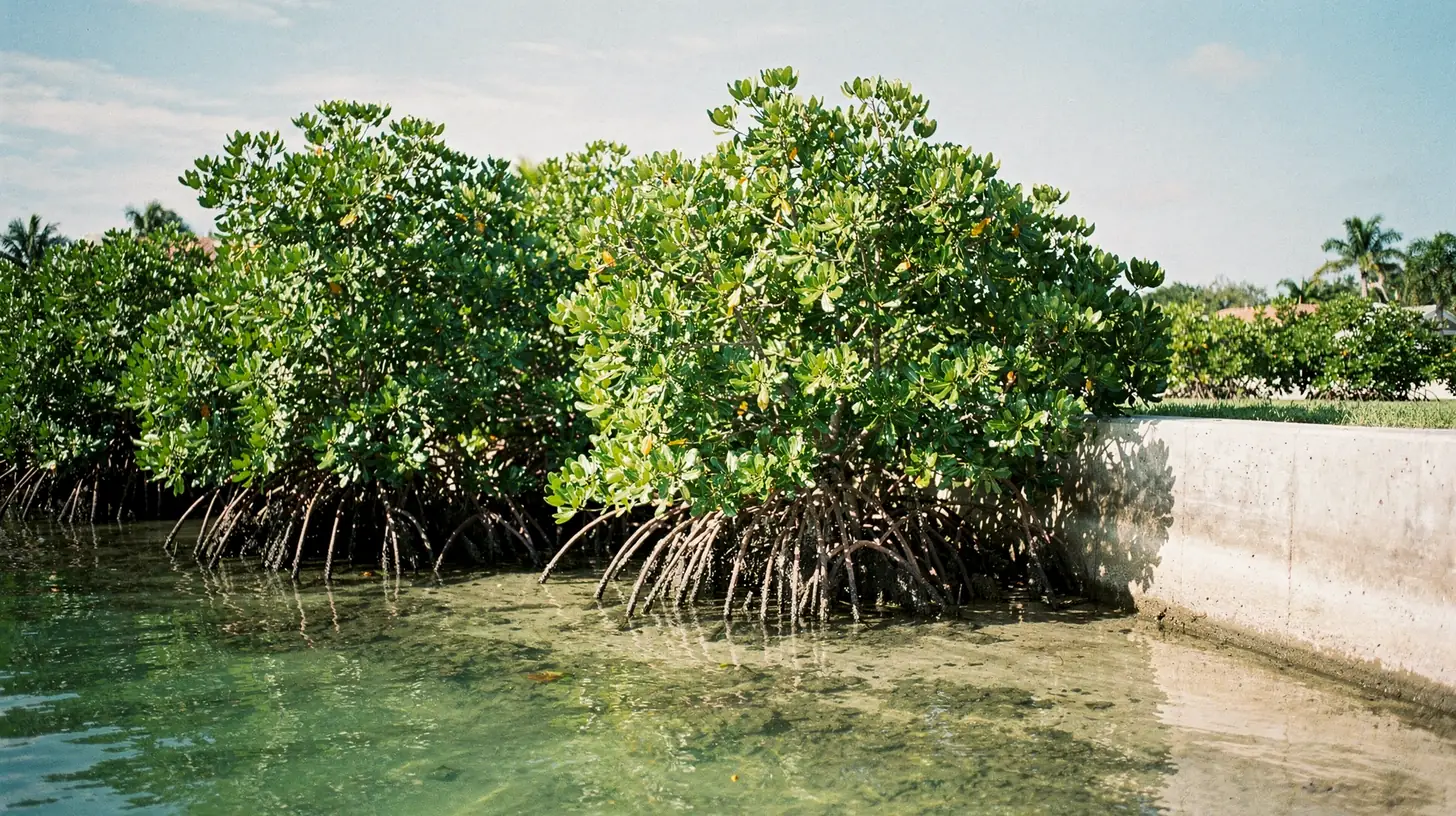
Start by clearing away the two beliefs that make this conversation impossible.
The first is that mangroves may never be touched. Florida requires a permit for trimming or alteration unless the work meets the exemption criteria the statute sets out, and it provides that a delegated local government may impose stricter substantive standards than the department for issuing such a permit but may not prohibit all mangrove trimming (Florida Statutes section 403.9328, 2025). Some trimming is contemplated by the law itself.
The second is that a waterfront owner may do as they like on their own frontage. The exemptions are bounded by specific heights, a percentage of the shoreline and a staged limit on how much foliage comes off in a year, all of which are set out in the next section.
What sits between those two positions is the part almost nobody explains. Florida provides a general permit route for trimming that does not qualify as exempt, with its own conditions, which means the choice is not simply between doing nothing and applying for a full permit (Florida Statutes section 403.9327, 2025). An owner who understands there are three tiers rather than two is already better informed than most of the market.
A necessary caution before any of the numbers below. This page describes published statute. It is not legal or permitting advice, requirements change, and a delegated local government may apply stricter standards where you are. The department and your county are the authorities on any particular shoreline, and nothing here should be treated as clearance to start cutting.
The Exemption Is Written in Feet and Percentages
Exempt riparian fringe trimming applies to mangroves not exceeding 10 feet in pretrimmed height, and no mangrove may be reduced below 6 feet. A professional mangrove trimmer may work up to 24 feet pretrimmed. A shoreline over 150 feet may not have more than 65 percent trimmed under an exemption, trees 16 feet or taller must be staged at no more than 25 percent of foliage annually, and no herbicide may be used (Florida Statutes section 403.9326, 2025).
These are the numbers a waterfront owner is actually searching for, and they are worth stating exactly.
Under the exemption provisions, riparian fringe trimming applies to mangroves that do not exceed 10 feet in pretrimmed height, and no mangrove may be trimmed so that its overall height is reduced to less than 6 feet. Where the work is carried out by a professional mangrove trimmer the pretrimmed height allowance rises to 24 feet, with the same 6 foot floor. Properties with a shoreline of 150 feet or less qualify differently from larger frontages, where no more than 65 percent of the mangroves along the shoreline may be trimmed under an exemption (Florida Statutes section 403.9326, 2025). Mangroves 16 feet or greater in pretrimmed height must be trimmed in stages so that no more than 25 percent of the foliage is removed annually, and no herbicide or other chemical may be used to remove foliage (Florida Statutes section 403.9326, 2025).
Look at how much content is sitting in that paragraph. What pretrimmed height means and how to measure it. Why the 6 foot floor exists. What happens on a lot with 200 feet of frontage. Why a 20 foot tree changes who can legally do the work. Why staging matters on a mature fringe. Each of those is a page, each answers a question a real owner is typing, and each is checkable against the statute.
For work that falls outside the exemptions there is the general permit route, and its conditions are equally specific. The riparian owner general permit requires that trimming is supervised or conducted exclusively by a professional mangrove trimmer, that the mangroves do not extend more than 500 feet waterward measured from the trunk of the most landward tree, that no more than 65 percent of the mangroves exceeding 6 feet in pretrimmed height are trimmed, that nothing is reduced below 6 feet, and that no herbicide is used (Florida Statutes section 403.9327, 2025). It may be used only once per property, and trimming proceeds in stages at no more than 25 percent of foliage annually (Florida Statutes section 403.9327, 2025).
The once per property condition is the kind of detail that changes a homeowner’s plan entirely, and it is exactly the sort of thing a contractor who knows the work can explain and a national content page never will.
Professional Mangrove Trimmer Is a Legal Category, Not a Boast
Florida defines who qualifies as a professional mangrove trimmer through published routes including certified arborists, professional wetland scientists, certified environmental professionals, certified ecologists, qualifying landscape architects, a minimum of 10 department-authorized mangrove-trimming projects, or a local government qualification program (Florida Statutes section 403.9329, 2025).
This is the part that should reshape how a firm doing this work presents itself.
Florida sets out routes by which a person qualifies as a professional mangrove trimmer. They include certified arborists certified by the International Society of Arboriculture, professional wetland scientists certified by the Society of Wetland Scientists, certified environmental professionals certified by the Academy of Board Certified Environmental Professionals, certified ecologists certified by the Ecological Society of America, persons licensed as landscape architects who meet the standards established by the board, persons who demonstrate competence through prior experience requiring a minimum of 10 mangrove-trimming projects authorized by the department, and persons qualified through a local government mangrove-trimming qualification program (Florida Statutes section 403.9329, 2025).
The statute also contemplates that a delegated local government may require a qualified trimmer to be registered with it, to pay an annual registration fee that may not exceed $500, to give written notice before trimming, and to be onsite when the work is performed (Florida Statutes section 403.9329, 2025).
So when a website says experienced with mangroves, that sentence is doing almost nothing. When it says which of those routes the firm qualifies under, and names the certification, it has stated something a reader can verify with the certifying body. That is a completely different class of claim, and it is the same move as publishing a license number rather than the word licensed, which we set out in what Florida requires your website to say.
It matters commercially because the exemption tier itself depends on it. A homeowner with 18 foot mangroves cannot lawfully rely on the general riparian fringe allowance, and the question of who is doing the work stops being a preference and becomes the thing that determines which tier the job sits in. A firm that can explain that clearly has just made the case for hiring itself without making a single claim about quality.
The Consequences Are Specific, Which Is Why This Content Converts
For second and subsequent violations Florida provides for penalties of up to $100 for each mangrove illegally trimmed or up to $250 for each mangrove illegally altered, with a separate penalty of up to $250 per mangrove on the professional trimmer, plus restoration or mitigation obligations (Florida Statutes section 403.9332, 2025).
Content about risk converts when the risk is concrete, and here it is unusually concrete.
First violations are handled under the general enforcement provisions the statute references. For second and subsequent violations Florida provides for penalties of up to $100 for each mangrove illegally trimmed, or up to $250 for each mangrove illegally altered, and separately provides for a penalty of up to $250 for each mangrove on the professional mangrove trimmer involved (Florida Statutes section 403.9332, 2025).
There are also restoration consequences. Where 5 percent or more of the trimmed mangroves are cut below 6 feet, subject to the stated exceptions, restoration is required by replanting in the same location with the same species or through offsite mitigation, and where that is impracticable mitigation may involve a donation or the purchase of mitigation bank credits at a 2 to 1 ratio, with any donation not less than $4 per square foot of created wetland area (Florida Statutes section 403.9332, 2025).
Note the separate penalty on the trimmer. That is a genuine differentiator for a firm that works inside the rules, because it means the contractor carries exposure of their own rather than simply doing what the homeowner asks. A page that explains this honestly is making the argument for careful work far better than any promise about craftsmanship.
Write it as information rather than as a scare. The owner reading it is usually trying to do the right thing and cannot find out what that is. Give them the tiers, the numbers, and the clear instruction to confirm with the department and their county before anything is cut, and you have been more useful than every competitor who left the question unanswered.
This Is the Same Buyer as Your Seawall and Dock Work
The person asking about mangroves owns waterfront in Collier or Lee County and is usually mid-way through a larger project. Structure the site so the shoreline questions connect, because that is how the owner experiences the property.
Worth recognizing who is actually on the page, because it changes what should sit next to it.
A homeowner researching mangrove rules almost always has a bigger picture in mind. They are dealing with a wall, or a dock, or a view, or a sale. The vegetation question arrives in the middle of that, not in isolation, which is why a mangrove page that dead ends is a wasted asset.
Connect it to the rest of the shoreline. Somebody working out what they may trim is frequently the same person working out what their seawall needs, which we cover in the permit questions waterfront owners ask. The two subjects share an audience, a geography and a regulatory instinct, and linking them honestly serves the reader as much as the site.
Structure by shoreline rather than by city, for the same reason that applies to marine work. What changes the mangrove job is the height and maturity of the fringe, the width of the frontage, whether the water is a canal or open bay, and how far the trees extend waterward. Those are the variables an owner can see from their own back yard, and they make far better pages than a set of near-identical city names.
And keep the map results on a separate track. Categories, service areas, photographs of real completed work and a steady flow of reviews decide who gets called, and no amount of writing replaces them.
What to Publish, and in What Order
Lead with the three tiers, then the measurable thresholds, then your qualification route, then the consequences. Date anything quoting a number and review it, and route every page to the department and the county rather than implying clearance.
A short order of work for a firm whose site currently says it handles mangroves.
First, the three tier explainer. Exempt, general permit, permit, and what separates them. This is the page that answers the question an owner is actually asking and it does not exist in most markets.
Second, the thresholds page, written so an owner can measure their own fringe: pretrimmed height, the 6 foot floor, frontage width and the percentage limit, and staging on mature trees.
Third, your qualification. Name the route you hold under the statute and the certifying body, so the claim is verifiable rather than decorative.
Fourth, the consequences page, written as information. Owners searching that question are trying to avoid a mistake, and they are excellent leads precisely because they are being careful.
Put a visible date on every page that quotes a figure, and state plainly on each one that delegated local governments may impose stricter standards and that the department and the county decide any particular shoreline. That habit is what keeps a reference page trustworthy as rules move, and it is the difference between a page that helps somebody and a page that gets them into trouble.
If you would rather see what your site currently answers and how it reads against the other firms working your waterway, our free audit measures it and costs nothing, and the ongoing work for this trade sits under SEO for landscaping.
Turn on what makes AI recommend you.
AI recommends the businesses it can read, trust and quote. Flip on the four signals we engineer, and watch your visibility climb and the answer rewrite itself.
Illustrative · the four signals are the real system we build
This article, answered.
The questions readers ask about this topic, answered the way an answer engine would. No forms, no sales pitch.
Pick a question on the left and you’ll get the direct answer, the way an answer engine would give it.
PUBLISHED September 2, 2026 · WRITTEN BY JAMIE KLONCZ, FOUNDER · SEO ELITE AGENCY, NAPLES FL
Enter a path and click verify.